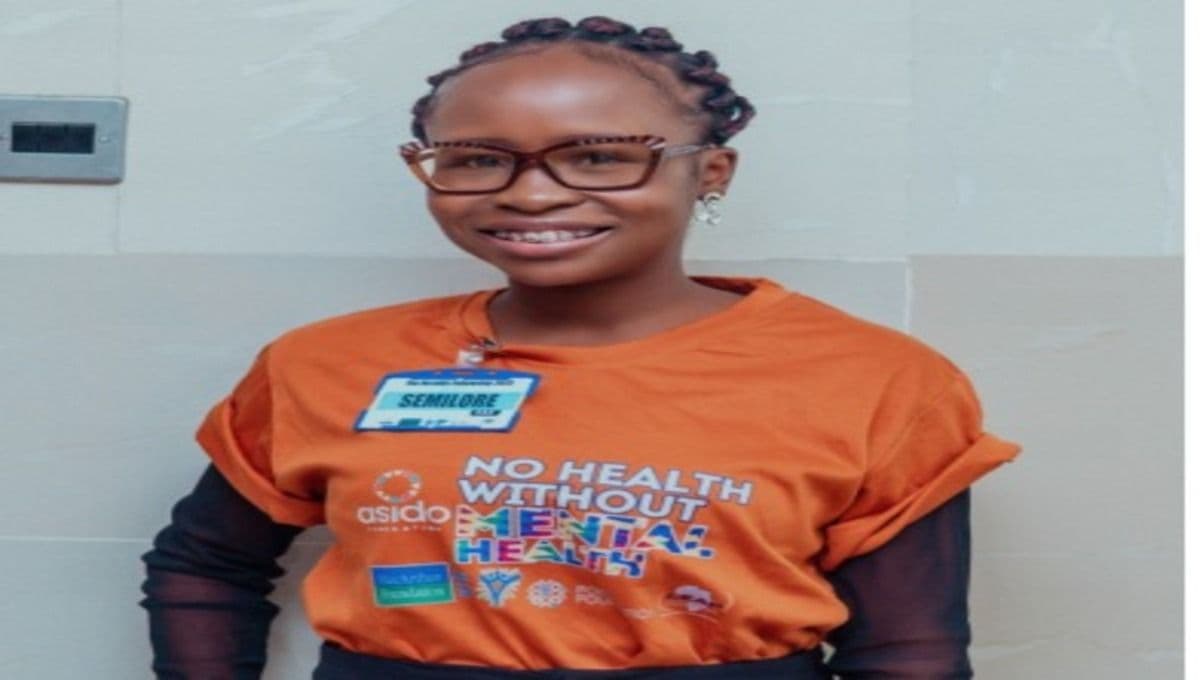
We're closing out Mental Health Month with a conversation with Oluwasemilore Marvelous Bolarinwa, a mental health advocate and Advocacy Director at Beyond the Past Mental Health Foundation, who is passionate about creating safe spaces for young people.
What drew you to mental health advocacy?
Honestly, it started from a desire to find myself and discover the unique value I could offer my community. As I started showing up and paying attention, I noticed how many people were struggling quietly, especially young people, but because of stigma and fear of judgment, they kept everything to themselves.
I noticed how easy it was for people to smile outwardly while silently dealing with stress, burnout, anxiety, and loneliness. That realization never left me. Mental health advocacy became the way I could intentionally create spaces where people feel heard, understood, and supported.
Did your own mental health journey play a role in why you became an advocate?
Yes, it did. In my journey to find myself, I tried a couple of things, but what made mental health advocacy stick was the fact that I could relate to it on a personal level. My personal journey taught me compassion and empathy in ways books and courses couldn’t. I know what it feels like to need support, reassurance, understanding, and even just someone willing to listen without judgment.
There were moments that challenged me emotionally and made me realize how important safe spaces and genuine conversations are. Those experiences shaped the way I see people and the way I show up for them now. They reminded me that healing isn’t always loud or linear, and sometimes people simply need to know they are not alone in what they’re feeling.
I believe that personal connection is what makes this work deeply meaningful to me.
What does your advocacy work actually look like day to day?
My advocacy work involves awareness, education, and creating safe spaces both formally and in everyday life. As the Advocacy Director of Beyond the Past Mental Health Foundation, I contribute to mental health campaigns, develop educational materials, and work with young people and teenagers to help them understand and take ownership of their mental wellbeing.
But honestly, some of the most meaningful moments happen in quiet conversations when someone pulls me aside and says 'I've never told anyone this before.' Those moments remind me why this work matters.
What’s one mental health myth you’re tired of hearing?
One mental health myth I’m really tired of hearing is: “You’re not depressed, you just need money.”
Yes, money is important and financial stress can definitely affect mood, but mental health is not that simple. It can’t always be explained by what someone has or doesn’t have.
The truth is, anyone can struggle with their mental health regardless of their age, background, or status. When we reduce it to finances alone, we end up dismissing what people are actually going through and that can make it even harder for them to speak up or seek help.
Mental health deserves more understanding than that.
As an advocate, how do you protect your own mental health?
I have a personal principle: whatever didn’t give me my peace cannot take it away from me. So I’m very intentional about my boundaries, I take breaks when I need to, and I allow myself to slow down without guilt.
I also stay close to people and activities that genuinely refill me, because I’ve learned I can’t pour from an empty place.
What’s one thing people can do today to support their mental wellbeing?
One thing people can do today to support their mental wellbeing is simply to CARE.
Connect with people who feel safe. Acknowledge how you're truly feeling instead of pushing it aside. Reach out for help when things feel too heavy to carry alone. And Embrace rest without guilt. Healing is not always loud or fast.
I created this as a simple reminder because I've seen how overwhelming it can feel to know where to start. You don't need a big plan. Just one small, honest step toward yourself is enough.
In your experience as an advocate, have you seen firsthand that mental health conditions are more common than people openly admit?
Absolutely. For my final year project, I conducted research on how mental health and wellbeing affect academic achievement in secondary school students. I realized that a large percentage of students were dealing with emotional and psychological challenges while still trying to function academically.
What stood out to me was how many of them were struggling silently, managing stress, pressure, and emotional distress without openly expressing it or seeking support. It really reinforced the reality that mental health struggles are far more common than people think, especially among young people.
Where would you point someone who wants to get help?
First, I tell them that seeking help is nothing to be ashamed of. Just start somewhere you feel safe, whether it's a therapist, counselor, trusted friend or support group. You don’t have to have everything figured out before asking for support. Sometimes taking that first step is already a huge part of the healing process.
ABOUT OUR GUEST

Oluwasemilore Marvelous Bolarinwa is a mental health advocate, educator, and SDG 3 champion dedicated to promoting awareness, healing, and wellbeing among teenagers and young adults. She serves as Advocacy Director at Beyond the Past Mental Health Foundation and a Leader at Voice of Healing and Hope Initiative.
A graduate of Obafemi Awolowo University and fellow of the Asido Foundation Herald's Fellowship, she has reached young people across Oyo and Osun States through outreaches, campaigns, and mental health conversations.
She was recognised as one of the 50 Outstanding Women at OAU and featured in Great Ife Women Magazine for her contributions to social impact and advocacy.
She believes no one should be ignorant about their mental health, and has made it her mission to change that.